
In our daily lives, we’re all about doing whatever we can to decrease tension. But when it comes to the lives of our fictional characters, we have to be willing …

Below you'll find a list of all posts that have been categorized as “b. Building a Scene”
In our daily lives, we’re all about doing whatever we can to decrease tension. But when it comes to the lives of our fictional characters, we have to be willing …

Are you in the middle of your NaNoWriMo project? By now, you might have 20-40K words written…and along with feeling tired, your scenes are feeling, well, tired. I get that. …
I hope you’re busy writing your amazing works of NaNoWriMo fiction!
I thought, as we dive in, it might help to understand what editors mean by “Show, Don’t Tell.” Listen, I know it can be confusing. Especially since there is not only mis-information and bad teaching out there, but also because there IS a time Tell!
Showing, not Telling is not about describing everything that happens. And Telling has nothing to do with narrative and backstory. Narrative and backstory (and even action) get a bad rap because often, during narrative, backstory and action, authors drop into “telling” without realizing it. Describing ACTION by saying “John shot Bill.” is not telling. It’s action. But adding: “John felt sorry when he shot Bill,” would be telling.
See, I know. Confusing.
Here’s the bottom line: Showing is about helping the reader experience the emotions of the character. Showing brings us into the mind and heart of the character to understand their emotional journey.
Here’s how: If you say, ‘She felt grief,’ or even, and this is more common, ‘Grief overtook her’ you are not just telling us what emotion she’s feeling, but you’re pinpointing one emotion your reader must feel with the character. Instead, show us how despair makes her feel through how she acts, what she thinks, what she says and how she sees her world. Let us into your character’s head.
Telling is when you tell someone how to feel. It relates to the emotion to the story, not the narrative, backstory and action.
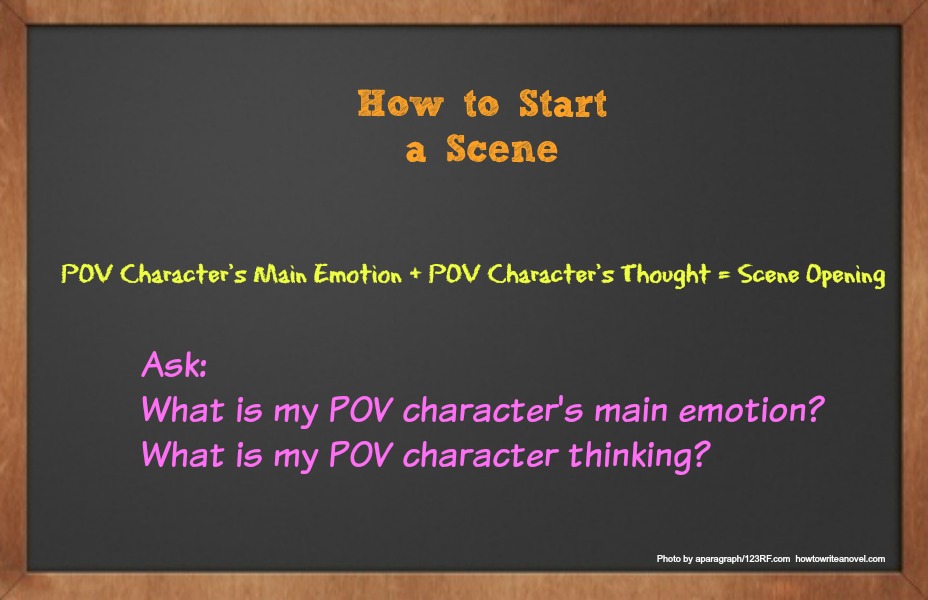
When you unpack a novel, it is nothing more – and nothing less – than a series of scenes strung together. String the scenes together in the proper order – …
Build in a Fear of Failure!
I am a closet SciFi junkie, and my current love affair is Falling Skies. I’ve been with them from the beginning and to be honest, I love the show not for the Sci-Fi, but for the characters. In short, I love the hero, and his three sons, and want them to survive.
I care about these Sympathetic Characters.
Which is why I found myself at the edge of my seat during last week’s episode. The hero, Tom Mason (played by Noah Wylie) and his oldest son, Ben, are trapped in a prison camp and need to escape. They’ve devised a wild plan to break through the electrical walls that holds everyone prisoner.
I realized the episode was fantastic when I found myself on my feet at the end of it.
Here’s the play of events – the hero has to distract the bad guys (skitters, or very large alien bugs) and get them to a building they’ve rigged to blow. In the meantime, Ben has to gather up all the prisoners and get them into the tunnels near their escape route. Finally, a third group, incidentally, a motley crew of soldiers who hate each other, has to climb over the wall with this homemade electric-repelling suit to get to the power supply and take down the electric wall.
If you are a fan and haven’t seen the episode, stop reading here.
The plan begins perfectly – Tom kills a guard, which brings out a horde of bugs, who chase him (he’s on a motorcycle) through the city, away from the escapees.